Job Quest: Turning resume writing and interview prep into a guided learning experience for entry-level job seekers
Pivot
Quest began as an exploration into reducing overwhelm in the job search process. Early on, we explored ways to support job seekers by gamifying the process through "Quests" and "Missions". However, through deeper investigation into the root cause of the problem and personal reflection, the focus of the project shifted.
What are the challenges that entry-level job seekers are currently facing?
As an entry-level job seeker myself, I experienced a recurring challenge: not knowing how to translate experience into clear, well-structured resume bullets that highlight impact, how to clearly talk about my projects, or how to avoid filler words during interviews.
The problem wasn't a lack of tools, it was how those tools were being used for guidance.
Entry-level job seekers are often expected to present themselves confidently in resumes and interviews without learning how to do so. Realizing I might not be the only one experiencing this challenge, we surveyed other entry-level job seekers to find out.
In our interviews and survey responses, this gap isn't about effort. It's about understanding and guidance. Without guidance, job seekers resort to over-reliance on templates, overusing filler words, or relying on tools that generate content without teaching transferable skills.
Entry-level job seekers need guidance, not more tools
We went deep into understanding the job search ecosystem, existing tools, and the challenges entry-level job seekers face. We researched existing platforms and analyzed their approaches to resume building and interview preparation.
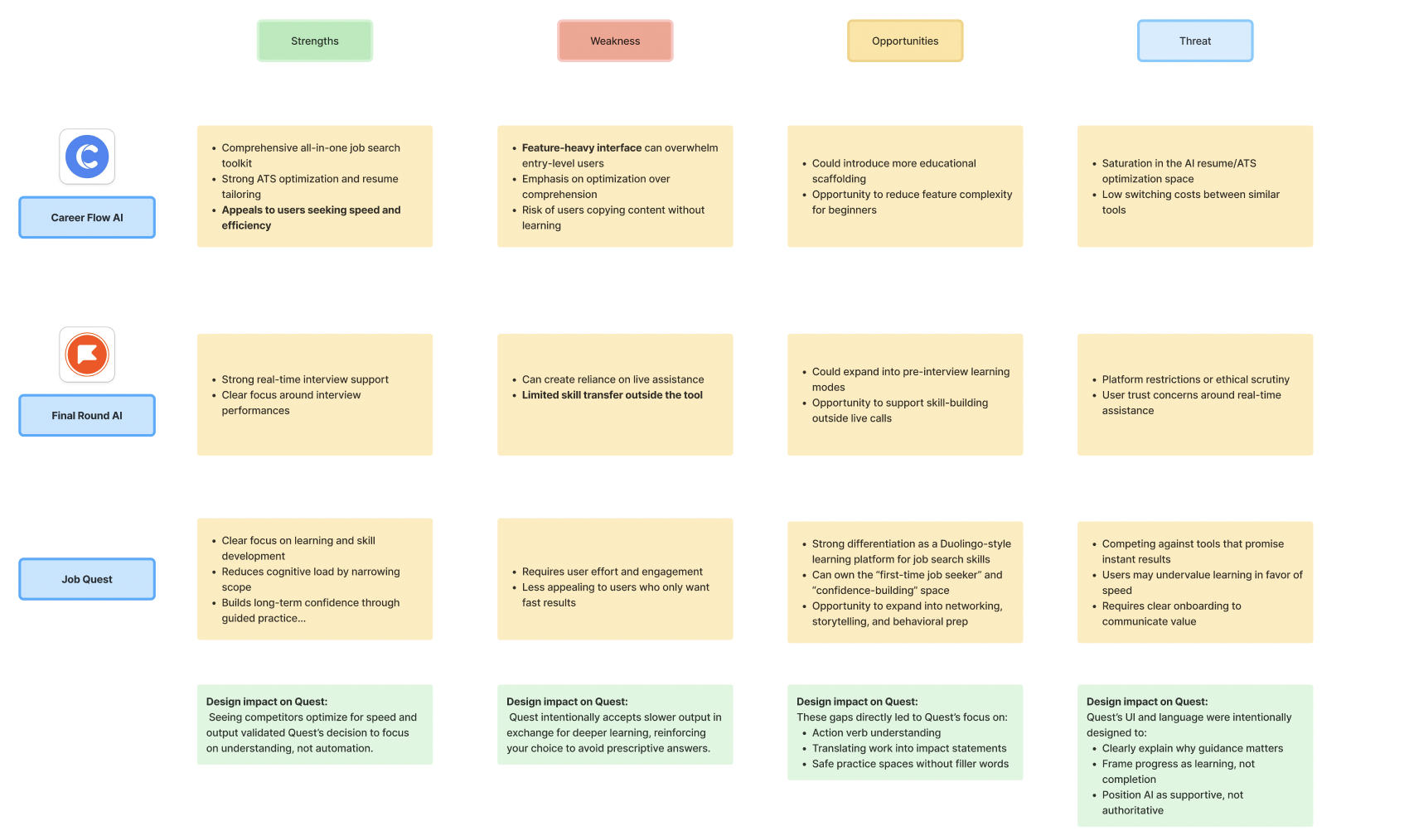
Job Quest SWOT analysis (Click to enlarge)
Guidance as the core of job search learning.
With that insight confirmed, our research shifted from what tools exist to how people actually use them. The SWOT analysis reinforced what we suspected: job seekers weren't short on resources, they were short on structure: the ability to know what to say and why it worked.
This insight reframed the product direction. Instead of optimizing for output, Quest evolved into a guidance-first learning experience, similar to Duolingo, designed to help entry-level job seekers learn how to:
- Write meaningful resume bullets that highlight impact
- Speak confidently about their projects and experience
- Practice interview responses without relying on scripted answers
With a guidance-first approach, Job Quest and its users will benefit from:
Exploring product direction and prioritization
With an 8-week timeline and limited development capacity, we prioritized features that supported learning and guidance rather than automation. We used the ICE prioritization framework (Impact, Confidence, Effort).
Strategic directions we explored:
While these features could improve efficiency and motivation, they risked prioritizing speed over learning and bypassing the guided practice and repetition needed for users to truly understand why certain job search strategies work.
Job Quest: the Guided Learning Experience that teaches job search skills, not replaces them.
To support learning without creating dependency on tools that automate content, we designed assistive patterns that focus on how to communicate ideas, because telling users what to say does not build long-term confidence.
Let us explore our attempt to solving the problem.
We identified the most intuitive way to bring guidance to life without relying on automation.
Insight 1: Guidance with explanations, not just outputs
Suggestions are paired with explanations that help users understand why certain wording works, not just what to use.
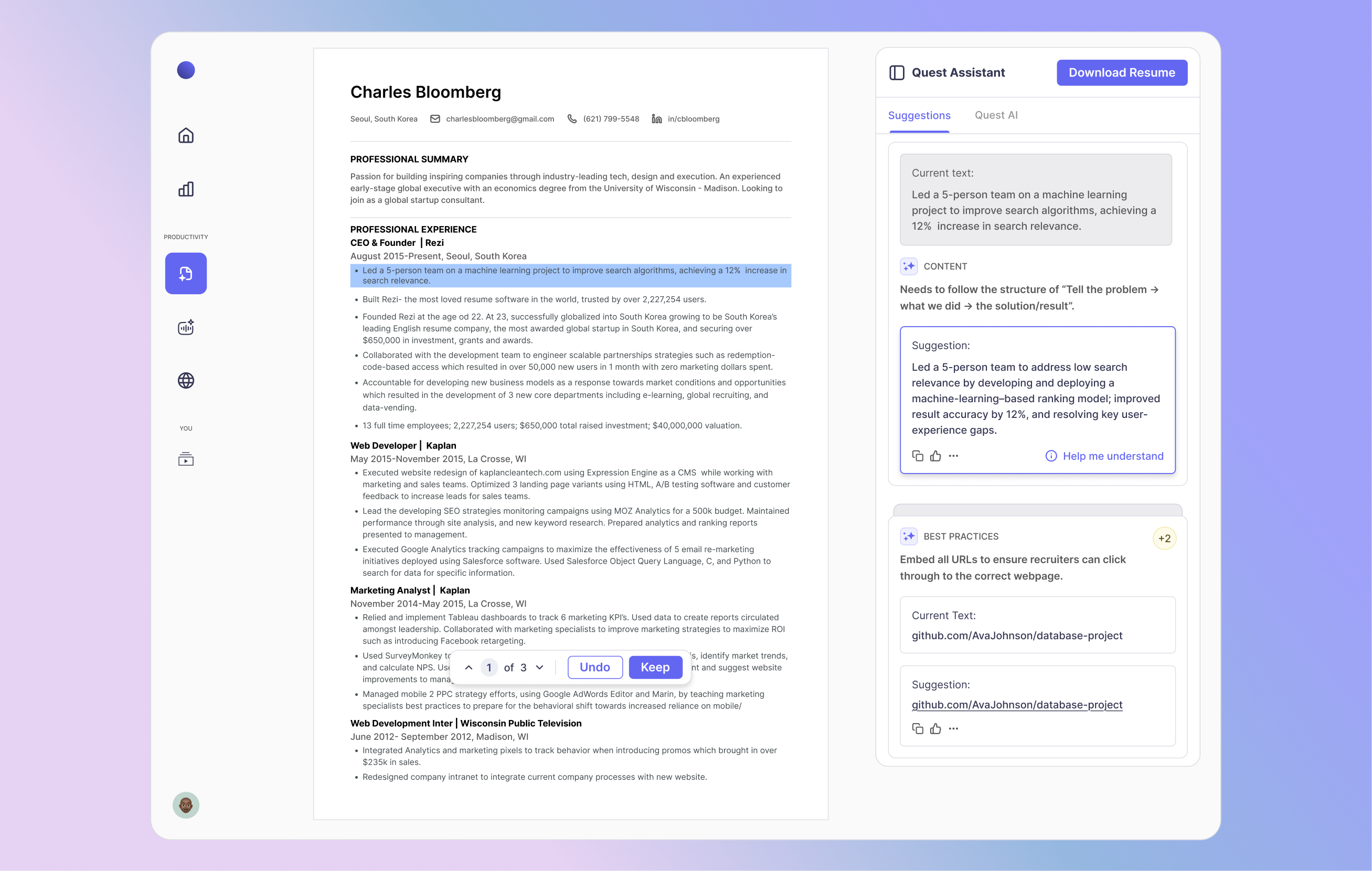
Insight 2: "Help me understand" option
"Help me understand" option allows users to explore the reasoning behind changes, building deeper understanding.
Key user flows that guide learning

Click to enlarge
Resume rephrasing suggestions
Users are able to learn how to structure their resume bullet points through the suggestions and move forward with Quest AI.
Click to enlarge
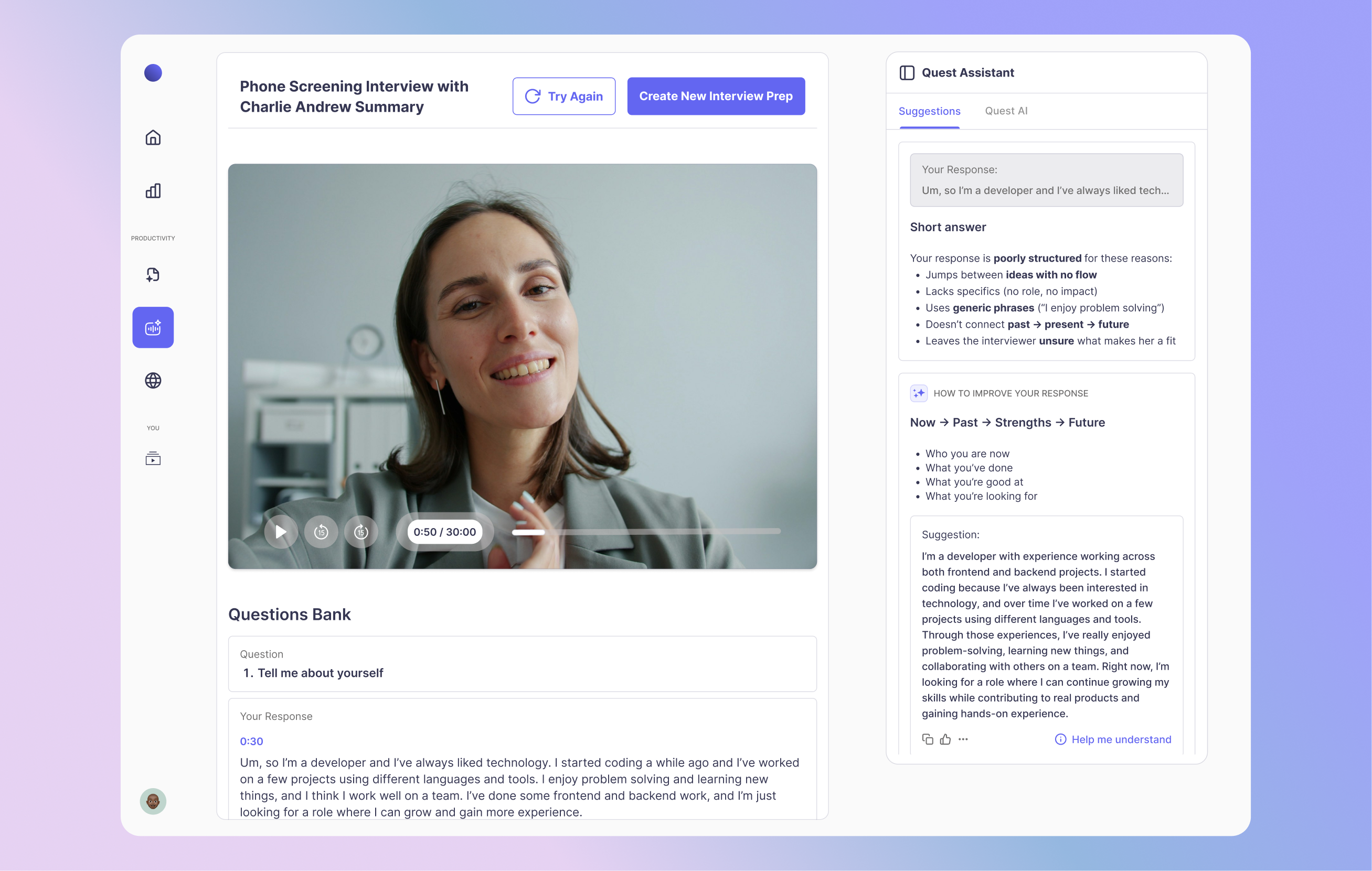
Practice space
A safe space to practice speaking without relying on filler words, with real-time feedback and explanations.
What I learned
Guidance matters more than automation.
Early-career users benefit most from support that helps them understand why things work, not just tools that speed up output.
Confidence comes from practice.
Repeated, guided practice helps users articulate their experience more clearly and reduces anxiety in resumes and interviews.
Designing for learning changes success metrics.
When the goal is skill-building, success is measured by understanding and confidence, not just completion.
What I'm Proud Of
Strong direction under constraints.
Within a short timeline, we aligned on a clear, learning-first vision and made intentional tradeoffs to support users' growth.
Next Steps
Expand guided lessons.
Extend the learning model to networking and behavioral interview scenarios.
Limitation: Untested with users
Our research and personal experience shaped the guidance-first direction, but the features that bring it to life: the suggestion patterns, the "Help me understand" option, and the practice space, haven't yet been tested with entry-level job seekers as part of their actual job search workflow. The guided learning experience is still a hypothesis, not a validated one.